Author: OOfYJn1wT8oKQm9eB3

Blood cancer: When drugs work

New marker found for the treatment of leukaemia patients

Patients suffering from acute myeloid leukaemia (AML) – a certain form of blood cancer – are treated with the help of chemotherapy. Often, the active substances Decitabine and Azacitidine – so-called DNA methyltransferase inhibitors – are used for older patients because those affected cannot tolerate intensive chemotherapy. But only some of the AML patients respond to this treatment. However, it is not yet possible to estimate which patients will benefit from these agents and which will not before starting therapy.

Supposedly equivalent drugs: important difference found

Recently, a multidisciplinary international team with cooperation partners from Germany, the USA and Great Britain carried out a study on this problem, which was funded by the Frankfurt Foundation for Children with Cancer and the association Hilfe für krebskranke Kinder Frankfurt. The scientists were able to show that the enzyme SAMHD1 converts the activated form of Decitabine back into its inactive initial form. This prevents therapeutic activity.

Interestingly, the effect of Azacitidine is not influenced by SAMHD1. The results, published under the title “Selective inactivation of hypomethylating agents by SAMHD1 provides a rationale for therapeutic stratification in AML” in the renowned journal Nature Communications, show that there are significant differences between these drugs, which are often considered equivalent. Furthermore, the amount of SAMHD1 in AML cells as a marker could predict how sensitive they are to Decitabine. This is of potential clinical importance.

Frankfurt scientist in international research team

The research was led by Prof. Jindrich Cinatl from the University Hospital Frankfurt and Prof. Oliver Keppler from the Ludwig-Maximilians-University Munich. Numerous research groups from the Goethe University Frankfurt as well as scientists from the universities of Göttingen, Greifswald, Munich, Münster, Cambridge and Kent in Great Britain and Yale/USA were involved. The first author of the study, Prof. Thomas Oellerich from Goethe University, said of the results: “There is now justified hope that patients will benefit from these new research results in the foreseeable future.” Prof Oellerich holds a professorship of the German Consortium for Translational Cancer Research. Together with the University of Mainz, the University Hospital is a site of this health centre, which is funded by the Federal Ministry of Education and Research.

Financial resources for research

Dr. Sjoerd van Wijk, group leader at the Institute of Experimental Cancer Research in Pediatrics, received a research grant from the German Research Foundation (DFG) to further expand his own research group working on the regulation of ubiquitination in cell fate control. Previous work of van Wijk focused on cellular aspects of ubiquitin conjugation and its relevance for cell survival, cancer progression and immunity against intracellular bacteria. In the upcoming three years, van Wijk aims to further understand of ubiquitination in cell death and survival in healthy and cancer cells using highly multi-disciplinary, state-of-the-art approaches. The Institute of Experimental Cancer Research in Pediatrics is partially funded by the Frankfurter Stiftung für krebskranke Kinder.

Contact:
Sjoerd J. L. van Wijk, PhD
Institut für Experimentelle Turmorforschung in der Pädiatrie
Phone: 069 67866574
E-Mail: s.wijk@kinderkrebsstiftung-frankfurt.de

Funding for Mildred Scheel Young Investigators Centre

The Mildred Scheel Young Investigators Centre in Frankfurt, whose spokesperson is Prof. Simone Fulda, is receiving funding of 10 million euros from German Cancer Aid. This makes the Department of Medicine at Goethe University and the University Hospital Frankfurt one of only five locations nationwide to benefit from the five-year funding programme.

After a very elaborate procedure, Frankfurt finally prevailed and also convinced the international reviewers. “We are extremely pleased about this funding. With the Mildred Scheel Young Investigators Centre, we want to advance the training of a new generation of researching physicians and cancer researchers and hope to gain completely new impulses and dynamics, coupled with expertise in applied cancer research,” says Prof Josef Pfeilschifter, Dean of the Faculty of Medicine and board member of the Frankfurt Foundation for Children with Cancer.

You can read the whole article from the magazine “WissenWird” here:

Article WissenWird

Breakthrough in leukaemia therapy

Movie/image: Influence of the cellular enzyme SAMHD1 on the antitumour effect of cytarabine (Ara-C) in acute myeloid leukaemia (AML) – cell line THP-1. Copyright Cinatl et al.

Until now, it has been impossible to predict which patients suffering from acute myeloid leukaemia (AML) will respond to standard cytarabine-based chemotherapy – and which will not. Therefore, all patients receive the same therapy, although only some will benefit from the treatment, which is associated with considerable side effects. Researchers from the Frankfurt Foundation for Children with Cancer and Goethe University have now discovered a new biomarker that can be used to identify patients who will respond to the therapy with a high degree of accuracy. In addition, the results open up new possibilities for treating leukaemia patients for whom no suitable therapy is currently available.

The active substance cytarabine forms the backbone of chemotherapies for the treatment of AML. In cancer cells, cytarabine is activated by the binding of phosphate groups. In his research group, funded by the Frankfurt Foundation for Children with Cancer, Prof. Jindrich Cinatl examined cytarabine-resistant AML cells from the Resistant Cancer Cell Line (RCCL) collection (www.kent.ac.uk/stms/cmp/RCCL/RCCLabout.html), which he runs together with Prof. Martin Michaelis (University of Kent, Canterbury, UK). Prof. Cinatl discovered that the toxicity of cytarabine to AML cells correlates with the concentration of the cellular enzyme SAMHD1, which makes it possible to predict the sensitivity of AML cells to cytarabine.

Based on this initial finding, a consortium led by Prof. Cinatl together with Prof. Oliver Keppler (who moved from the Institute of Medical Virology at Goethe University to Ludwig-Maximilians-Universität Munich during the study) subsequently showed that the enzyme SAMHD1 cleaves phosphate groups from the activated form of cytarabine and converts cytarabine back to its inactive form.

In a collaboration with clinicians (led by Prof. Hubert Serve, Medical Clinic II, Goethe University), it was shown that the SAMHD1 concentrations found in leukaemia cells also enabled AML patients who benefit from cytarabine-based chemotherapies to be identified clinically with high accuracy. This makes SAMHD1 a new clinical biomarker that allows cytarabine-based therapies to be targeted to AML patients who are highly likely to respond to the treatment and to spare patients who are highly unlikely to respond the toxic side effects. In addition, the group led by Frankfurt researchers showed that inhibiting SAMHD1 sensitises AML cells to cytarabine, opening up new treatment options for leukaemia patients for whom there are currently no effective treatments.

The results were published in the scientific journal Nature Medicine and can be found at the following web address:

https://www.nature.com/articles/nm.4255

We are proud that through your donation, the Frankfurt Foundation for Children with Cancer can make cutting-edge research for the treatment of children with cancer possible.

For more information on how you can support us, please click hier.

Press release

Prof. Dr. Jindrich Cinatl

First steps on the way to a new cancer drug

Researchers from Frankfurt and Kent successful in finding ways to overcome resistance

FRANKFURT. Researchers from Goethe University and the University of Kent (UK) have found the first step towards a new generation of cancer drugs capable of inhibiting drug resistance.

With its research, the international team led by Professor Jindrich Cinatl of Goethe University and Professor Martin Michaelis of Kent’s School of Biosciences has paved the way for tailored drug combinations that could increase the effectiveness of treatments, especially for patients with treatment-resistant cancers.

Drug resistance is a common reason for the failure of cancer therapies, and is thus responsible for the death of many patients. Despite great advances in the treatment of cancer over the past decades, cures are still mainly achieved when cancer is detected early and treated locally in the form of surgery and radiotherapy. Once the cancer cells have spread throughout the body and formed metastases (secondary tumours), the prognosis is bleak: the survival rate after five years is then less than 20 percent.

Therefore, effective drugs are urgently sought to help improve the chances of patients with metastatic cancer systemically. However, many cancers carry resistance and do not respond to any therapy from the time of diagnosis, others initially respond to therapies, but then the cancer cells become resistant.

The most important resistance mechanism in cancer cells is probably the function of so-called ATP-binding cassette (ABC) transporters. These are drug pumps that transport cancer drugs out of cancer cells. ABCB1 (also called multi-drug resistance gene 1 (MDR1) or P-glycoprotein) is the most significant of these. However, previous attempts to target ABCB1 as part of cancer therapy have failed.

One important reason for this is that ABCB1 is found in many places in the body, but especially at tissue boundaries such as the junction of the stomach and intestine and the bloodstream and brain. This used to mean that drugs that inhibited ABCB1 were not suitable for the desired interaction of cancer drugs with ABCB1 on cancer cells. Instead, the distribution of many different drugs and dietary components in the body was affected, leading to toxic side effects.

The research presented here shows that certain inhibitors of ABCB1 (produced in the research group of Prof. Manfred Schubert-Zsilavecz, Goethe University) interact in a special way with the ABCB1-mediated transport of certain cancer drugs. This represents a first step towards the development of customised combinations of anticancer drugs and ABCB1 inhibitors that specifically induce the accumulation of anticancer drugs in ABCB1-expressing cancer cells but have no effect on the distribution of other drugs or food components in the body.

In addition to Professor Michaelis and Professor Cinatl and their colleagues, the team also included Prof. Manfred Schubert-Zsilavecz (Goethe University), Professor Michael Wiese (University of Bonn), Dr Mark Wass (University of Kent) and Dr Taravat Ghafourian (University of Sussex) and their research groups.

Prof. Cinatl’s research group was additionally supported by the association “Hilfe für krebskranke Kinder” and its foundation “Frankfurter Stiftung für krebskranke Kinder”.
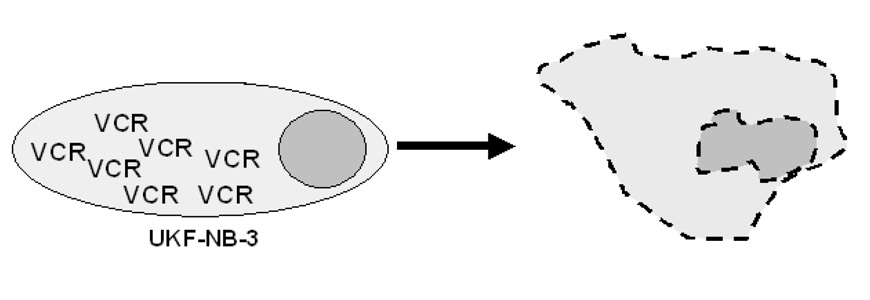
A tumour cell (here the neuroblastoma cell UKF-NB-3) is treated with a cytostatic drug (here with vincristine [VCR]) and dies.
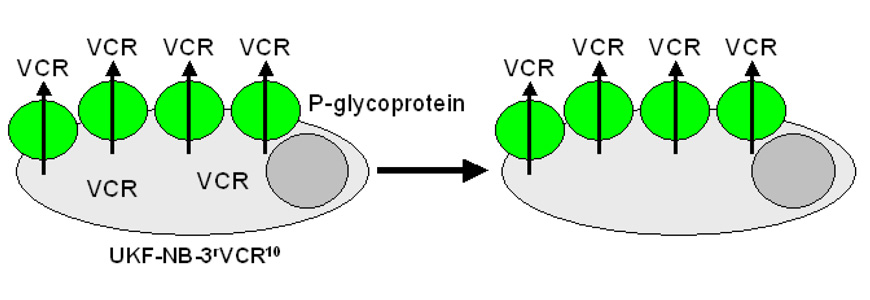
Here, a chemoresistant neuroblastoma cell (UKF-NB-3 resistant to vincristine) is also treated with vincristine. However, the chemoresistant cell has the ABC transporter P-glycoprotein (green circles). The result is that vincristine is pumped out of the cell by Pglycoprotein, so that vincristine cannot take effect and the chemoresistant tumour cell does not die.
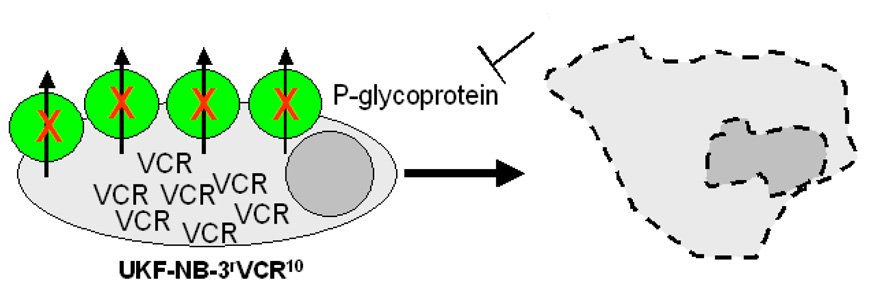
If the function of the P-glycoprotein in the chemoresistant cell is disturbed by specific inhibitors (here red crosses), the P-glycoprotein can no longer transport vincristine out of the cell, vincristine takes effect and the chemoresistant tumour cell dies.


Publication: Substrate-specific effects of pirinixic acid derivatives on ABCB1-mediated drug transport, in: Oncotarget.

See here: http://www.impactjournals.com/oncotarget/index.php?journal=oncotarget&page=article&op=view&path[]=7345&author-preview=5o1

Explanatory graphics for download at  www.uni-frankfurt.de/60434613

Information:
Prof. Dr. Jindrich Cinatl, Institut für Medizinische Virologie, Goethe-Universität Frankfurt; cinatl@em.uni-frankfurt.de; +49 69 6301 6409; Dr. Florian Rothweiler; f.rothweiler@kinderkrebsstiftung-frankfurt.de; +49 69 6786 6572.

Press release in English:
http://www.goethe-university-frankfurt.de/60434202/11


Goethe University is a strong research university in the European financial metropolis of Frankfurt. Founded in 1914 with purely private funds by free-minded citizens of Frankfurt, it is still committed to the motto “Science for Society” in research and teaching. Many of the men and women who founded the university in the early days were Jewish donors. In the last 100 years, Goethe University has made pioneering achievements in the fields of social and economic sciences, chemistry, quantum physics, brain research and labour law. On 1 January 2008, it gained a unique degree of autonomy by returning to its historical roots as a foundation university. Today it is one of the ten universities with the most third-party funding and three largest universities in Germany, with three clusters of excellence in medicine, life sciences and the humanities.

Publisher: The President
Editorial office: Dr. Anke Sauter, Science Editor, Department of Marketing and Communication, Theodor-W.-Adorno-Platz 1, 60323 Frankfurt am Main, Tel: (069) 798-12477, Fax: (069) 798-763 12531, sauter@pvw.uni-frankfurt.de

Internet: www.uni-frankfurt.de
Jan Lütt Sub-foundation

A sub-foundation established in memory of Jan Lütt is intended to continuously and sustainably improve the palliative care of children and adolescents suffering from cancer who are being treated at the Clinic for Paediatrics and Adolescent Medicine of the Goethe University Hospital, Frankfurt am Main.

The proceeds of the sub-foundation are to be used to finance training and further education for the staff of the psychosocial service to improve palliative care and to enable the deployment of a staff member or team of staff members to accompany children or young people suffering from osteosarcoma. Targeted donations for this purpose can also be made via a separate account set up for this purpose.


Frankfurt Foundation for Children with Cancer
Jan Lütt
Frankfurter Sparkasse

IBAN: DE23 5005 0201 1247 0714 97
BIC: HELADEF1822

Children’s cancer research at the highest level

The research groups based in the research house of the Frankfurt Foundation for Children with Cancer have been provided with the high content imaging device “ImageXpress Micro XSL” from Molecular Devices GmbH, a research method that is used in the pharmaceutical and biotechnology industries, as well as in renowned research institutes, to develop new strategies and drugs to combat a wide range of diseases. The ImageXpress Micro XLS is equipped with a transmitted light option and the ability to observe live cells. Until now, some of our research projects have been recorded and analysed manually using imaging techniques. In contrast, the fully automated Epi-Fluorescence Microscope offers the possibility to automate the work steps to a high degree. We expect this to accelerate, but above all to improve the quality of the research methods. Better standardisation, simpler processes, faster evaluation of results and a higher sample throughput should help to advance the research projects we support in childhood cancer research even more successfully.

If you would like to support our research, then you have the opportunity here to support specific acquisitions/projects or also the operation of the Research House in general with your donation.

Klaus Vogel Office Technology

For the second year in a row, Klaus Vogel Bürotechnik GmbH, based in Frankfurt, has dispensed with traditional Christmas presents for its customers and decided to support regional charities instead.

As one of the leading providers in the Rhine-Main region, the document system house develops professional and optimally adapted concepts for efficient printing and document processes. For more than 25 years, the Frankfurt-based family business has been offering its customers innovative and high-quality products in combination with competent support for all aspects of document creation, processing and archiving.

Patrick Vogel, Managing Director of Klaus Vogel Bürotechnik GmbH, said about the reason for the donation to the Frankfurt Foundation for Children with Cancer: “Especially at Christmas time, we want to pause and realise how lucky we are to be healthy. At the same time, it is important to us to think of the people who were not able to experience such happiness. As the father of a young daughter, cancer research, especially in the field of children and young people, is naturally close to my personal heart. If we can somehow contribute to improving the chances of success in curing cancer, we are very happy to do so.”

After a very informative and impressive tour of the premises and the research facility, Patrick Vogel presented a donation cheque for 2,500 euros to Managing Director Rudolf Starck.

Contact

Frankfurt Foundation
for children with cancer
Komturstraße 3a
60528 Frankfurt

Phone +49 (0)69 678665-0
Fax +49 (0)69 678665-94

info@kinderkrebsstiftung-frankfurt.de

Donation account

Frankfurter Sparkasse 1822
IBAN: DE43 5005 0201 1245 6354 40
SWIFT-BIC: HELADEF1822

Charity shopping

Make a good deed out of every online purchase and support the Frankfurt Foundation for Children with Cancer. It's easy to do so via Gooding

Gooding

Here's how Gooding works:
Jubiläumslogo